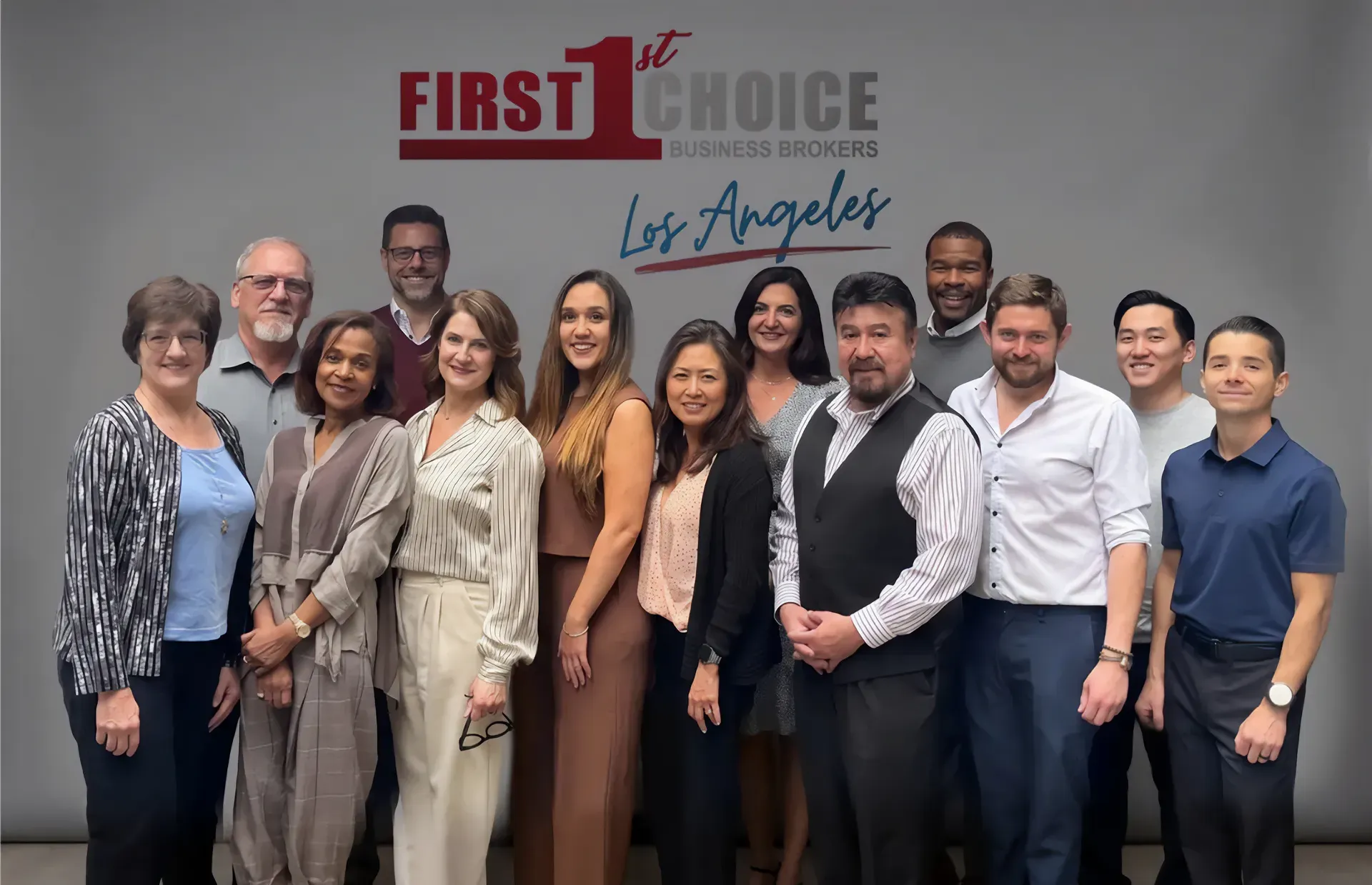
First Choice Business Brokers Los Ángeles

Vendemos empresas y concretamos negocios.


Servicios expertos para compradores y vendedores en la venta de negocios del mercado medio y de la calle principal

Empezar

Corredores de negocios de primera elección Los Angeles

Vendemos empresas y concretamos negocios.


Servicios expertos para compradores y vendedores en la venta de negocios del mercado medio y de la calle principal

Empezar

First Choice Business Brokers Los Angeles

First Choice Business Brokers Los Ángeles

¡AYUDANDO A NUESTROS CLIENTES A COMPRAR Y VENDER NEGOCIOS TODOS LOS DÍAS!


First Choice Business Brokers, Los Ángeles es una firma de corretaje de negocios y asesoría en fusiones y adquisiciones de primera calidad que ofrece un servicio completo y se enfoca en brindarles a nuestros clientes un servicio profesional de NIVEL SUPERIOR. Nos encargamos de todo el proceso de venta, que incluye la valoración de empresas, la comercialización confidencial de las mismas, la investigación de los compradores, la gestión de reuniones entre compradores y vendedores, la preparación de la documentación de la transacción y la gestión de los procesos de depósito en garantía, arrendador y financiamiento para garantizar un proceso de transacción sin inconvenientes.


First Choice Business Brokers, Los Ángeles se especializa en ventas comerciales en todas las industrias para pequeñas y medianas empresas.


Somos los corredores de negocios más experimentados y confiables de Los Ángeles y hemos ayudado a cientos de personas como usted a comprar o vender un negocio en el sur de California.
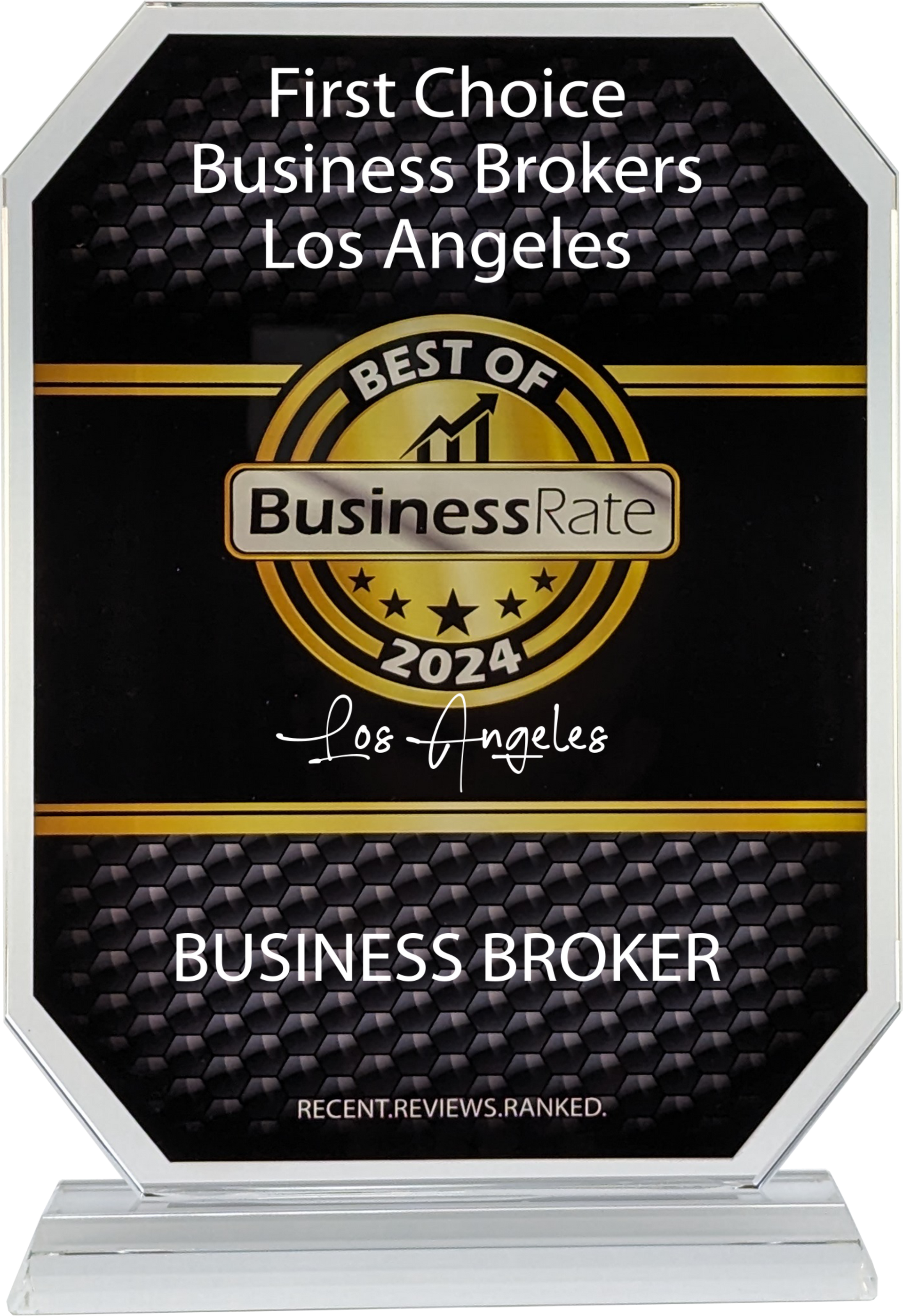
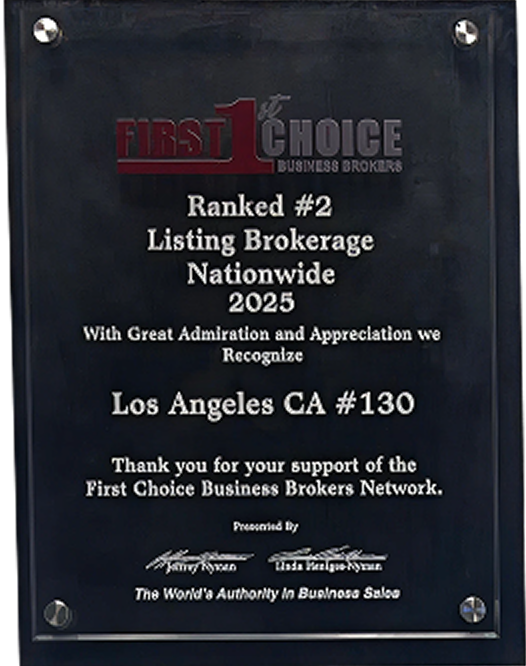
A plaque that says first choice business brokers los angeles

Alcance nacional, experiencia local

Conectando a emprendedores con oportunidades en toda América del Norte

130

Territories Served

278

Business Brokers

$18 B

In Listed & Managed Business Listings

¿Por qué elegir First Choice Business Brokers en Los Ángeles?

  • Empresa nacional consolidada con más de 70 oficinas en todo Estados Unidos.
  • Especializado en Ventas de Empresas y Asesoramiento en Fusiones y Adquisiciones
  • Proceso de venta confidencial
  • Contratos propietarios y completos
  • Acceso a amplias redes de compradores
  • Marketing en múltiples canales del mercado empresarial
  • Análisis financiero exhaustivo y valoración
  • Historial de éxito comprobado
  • Servicio Profesional con Integridad
  • Experiencia especializada y experiencia en transacciones
  • Tecnología propia y CRM personalizado
  • Estrategias de marketing probadas y automatización
  • Umbral más bajo que un banco de inversión
  • Sin cargos por adelantado

Nuestros servicios

Desde la intermediación comercial hasta fusiones y adquisiciones; somos especialistas en venta de negocios.


Ventas comerciales

Servicios de listado confidencial para propietarios de empresas que desean vender.

Enumere su negocio

Valoración de empresas

En todas las oficinas de First Choice se ofrecen servicios de valoración experta.

Evaluación empresarial gratuita

Asesoramiento en fusiones y adquisiciones

Nuestros profesionales de ventas guían a los compradores comerciales a través del proceso de compra empresarial.

Servicios de fusiones y adquisiciones

Búsqueda de empresas

Encontrar el negocio adecuado para sus intereses, requisitos de ingresos y ubicación.

Encuentra negocios en venta

Ventas comerciales

Servicios de listado confidencial para propietarios de empresas que desean vender.

Enumere su negocio

Valoración de empresas

En todas las oficinas de First Choice se ofrecen servicios de valoración experta.

Evaluación de negocios GRATUITA

Asesoramiento en fusiones y adquisiciones

Nuestros profesionales de ventas guían a los compradores comerciales a través del proceso de compra empresarial.

Servicios de fusiones y adquisiciones

Búsqueda de empresas

Encontrar el negocio adecuado para sus intereses, requisitos de ingresos y ubicación.

Encuentra negocios en venta

¿Vendiendo un negocio?

Obtenga el máximo valor para su negocio con First Choice Business Brokers. Comience aquí

¿Comprar un negocio?

First Choice Business Brokers le ayudará a encontrar la empresa perfecta. Comience aquí

Valora mi negocio

Descubra cuánto vale su empresa en el mercado actual. Comience aquí

Negocio en venta Busqueda rapida

Desde intermediación empresarial hasta fusiones y adquisiciones; somos especialistas en venta de empresas.

La autoridad mundial en ventas comerciales

Red inigualable

Conectando compradores y

vendedores a nivel nacional

12.500 millones de dólares en listados de empresas

Cientos de empresas se suman a nuestra lista anualmente

Líderes de la industria

Décadas de experiencia en ventas comerciales exitosas

Negocios Destacados En Venta

¿Listo para invertir en su futuro?

Descubra su agente de negocios de confianza en Los Ángeles

Somos su socio de crecimiento en Los Ángeles, California, y nos dedicamos a guiarlo hacia el éxito con nuestro servicio de intermediación comercial. Maximicemos juntos el potencial de su negocio.

Escúchalo de nuestros clientes

Descubra lo que nuestros clientes dicen sobre su experiencia con nosotros.

Últimas noticias de negocios

Las últimas noticias sobre la compra y venta de su negocio

City Skyline representing growth , opportunity, and business value in a changing economy.
Por Ardeshir Vosooghi 9 de septiembre de 2026
Discover why business value is still being built in today’s changing world—and how owners can create a stronger, more transferable business.
21 de agosto de 2026
Searching for merger and acquisition services in Los Angeles usually means you're on one side of a deal, but which side changes everything about the service you actually need. Direct answer: sell-side M&A advisory represents the business owner going to market, managing valuation, marketing, and buyer outreach on the seller's behalf; buy-side services, also called buyer representation, represent the person or company trying to acquire a business, running the search, vetting targets, and negotiating on the buyer's behalf. The two roles work toward opposite outcomes in the same transaction, which is exactly why they're structured as separate services. Quick Answer: Sell-side M&A advisory works for the seller and is paid by the seller at closing. Buy-side (buyer representation) works for the buyer, requires proof of funds upfront, and is typically compensated with a success fee upon closing a deal. Sell-side M&A services represent the business owner selling, handling valuation, marketing, and buyer identification. Buy-side services (buyer representation) refer to the person or company doing the acquiring, running the search, vetting targets, and negotiating on the buyer's behalf. Whichever seat you're in determines which service you need. What Sell-Side M&A Advisory Covers Sell-side representation is built around one goal: getting the business owner the best achievable outcome when selling. That typically runs through a structured process: Initial consultation to define the seller's goals and compile financial documentation Market Price Analysis, a valuation grounded in the business's actual financials and comparable transactions Marketing, confidential business profiles and outbound outreach to strategic buyers, not just a public listing Buyer pool development, vetting interested buyers, requiring signed NDAs, and confirming proof of funds before releasing sensitive information Negotiation and offer management, fielding LOIs and purchase agreements, sometimes across several rounds Due diligence and closing, coordinating with the buyer's CPA and attorney through to a neutral closing entity Throughout, the sell-side advisor's job is to protect the seller's price and terms, not to make the deal easiest for the buyer. What Buy-Side Services (Buyer Representation) Cover Buyer representation flips the relationship. Instead of marketing a business, the broker runs a custom search on behalf of someone trying to acquire one, often described as finding the needle in the haystack across a market flooded with generic listings. The process starts with the buyer clearly defining what they're looking for: industry, target income level, location, and deal size. From there: Proof of funds is required upfront. A broker won't commit real search time without confirmation the buyer can actually close. The search isn't limited to active listings. If the right business isn't currently for sale, the broker will reach out directly to "plant the seeds" with an owner who may consider selling down the road, a meaningfully different job than marketing a public listing. Negotiation runs in the buyer's favor. The broker negotiates price and terms on behalf of the buyer, not the seller. Compensation is typically a success fee. Buyer-side brokers are usually paid only once a deal actually closes, which is why proof of funds and a clear mandate matter so much upfront. The Practical Differences, Side by Side
21 de agosto de 2026
If you're researching business valuation services in Los Angeles because you're weighing a sale, here's the direct answer: the biggest value-killers aren't the obvious ones. Sellers lose money by pricing off revenue instead of cash flow, failing to properly document add-backs, ignoring how much of the business rides on one or two customers, and walking into due diligence with financials that don't hold up to scrutiny. Every one of these is fixable before you go to market, which is exactly when fixing them actually helps your price. Quick Answer: The mistakes that most often cost LA sellers money are pricing off top-line revenue instead of cash flow, unsubstantiated add-backs, unaddressed customer concentration, and outdated market comparisons, all things a proper valuation catches before a buyer does. The valuation mistakes that cost Los Angeles sellers the most money aren't dramatic, they're things like pricing off revenue instead of cash flow, skipping add-backs, ignoring customer concentration, and going to market with messy books. Fixing these before you list, not after a buyer's due diligence team finds them, is what protects your price. #1: Pricing Off Revenue Instead of Cash Flow A business doing $3 million in revenue and a business doing $1.5 million can be worth the same amount, or the second one can be worth more, it depends entirely on what's left after expenses. Buyers value a business on its cash flow (Seller's Discretionary Earnings or EBITDA, depending on size), not its top line. Sellers who anchor their price expectations to revenue, or to what a competitor "sold for" without knowing the underlying multiple, routinely price themselves either out of the market or leave money on the table. #2: Add-Backs Without Documentation Add-backs, owner's salary above market rate, personal expenses run through the business, one-time legal costs, and similar items, are a legitimate part of showing a business's true earning power. The mistake is claiming them without paper trails. A buyer's CPA will challenge every add-back during due diligence, and unsupported ones don't just get rejected, they can undermine the seller's credibility on everything else in the financials. Document each one as you go, not retroactively when a buyer asks. #3: Ignoring Customer Concentration A business where one or two customers represent a large share of revenue looks strong on paper and gets discounted hard in practice. Buyers see customer concentration as risk: what happens to the business if that one relationship walks after the sale? Sellers who don't proactively address this (through diversification before selling, or at minimum a clear narrative and contracts that make the relationship transferable) are often surprised when it shows up as a lower offer or a request for an earnout tied to customer retention. #4: Relying on Outdated or Generic Comparisons "I heard a similar business sold for X" is not a valuation methodology, comparisons need to account for industry, deal size, growth trajectory, and how recently the comparable transaction closed. Buyer competition itself varies sharply by deal size: in the first quarter of 2026, 83% of deals over $5 million attracted at least three offers, and 18% drew ten or more bids, while smaller deals under $500,000 often received just one or two offers. That means the valuation dynamics for a Silicon Beach tech company and a San Fernando Valley service business aren't just different in multiple, they're different in how many buyers are actually competing for the deal, which itself affects where the final price lands relative to the initial number. #5: Emotional Pricing It's natural to price a business you built over 20 years based on how much of yourself is in it. Buyers don't price it that way. A Market Price Analysis grounded in your actual financials, industry standards, and comparable transactions, not sentiment, is what holds up once real offers start coming in. Sellers who skip this step and set their own number based on what they feel it's worth tend to sit on the market longer and eventually negotiate down further than they would have with a defensible number from the start. #6: Going to Market With Messy Books Even a genuinely strong business loses leverage if its financials don't reconcile cleanly. Buyers and their advisors read messy bookkeeping as risk, and risk gets priced in as a discount, or as a due diligence process that drags on long enough to kill momentum. Three years of clean, consistent financials, ideally reviewed by an accountant before you list, is one of the highest-leverage things a seller can do before a valuation even happens. What a Proper Valuation Actually Catches A comprehensive Market Price Analysis exists specifically to surface these issues before a buyer does, reviewing your assets, inventory, income statements, and intangible value against real market data and comparable transactions, rather than a single revenue multiple pulled from a general search. That's the difference between a number that survives due diligence and one that doesn't. Frequently Asked Questions